
The key points from this article
- Circuit training with your own weight is often the fastest way to feeling "I did something for myself".
- You have 20 minutes, some space and your own body.
- For a personal choice, continue with a recommendation after reading.
Products most closely related to this topic
If you want to compare concrete options after reading, these products are the closest match to the article topic.
 Arctic Sea Omega
A supplement for energy, heart and circulation routines when you want longer-term daily support.
Useful to compare when you are looking for energy, focus or vitality support. Forever Fiber - FIBER
A simple fiber add-on when you want digestion and satiety support during the day.
It fits topics such as appetite, portions, energy or a weight-management routine. Forever ESM Complex – Joint Support!
Support for a mobility routine when joints, movement and everyday flexibility are the topic.
Useful to compare when joints, bones or mobility are the topic.Circuit training with your own weight (20 min): a quick plan for strength, fitness and better focus
Circuit training with your own weight is often the fastest way to feeling"I did something for myself". You have 20 minutes, some space and your own body. That's enough. You might be wondering if it can really be effective. Here's the thing: quality and pace do most of the work. You don't need machines to get your heart rate up. You don't need a gym to strengthen your legs and core. You need a clear plan and a calm head. In this guide you will receive a precisely structured training. You will also get rules that protect the joints. You will learn how to adapt the exercises to your level. At the end, you will also know how to measure progress. No obsession and no complications.
Why 20 minutes is often enough
The biggest obstacle to training is time. Another obstacle is mental resistance. A short routine breaks both barriers. You start more often. It brings results.
In circuit training, intensity of work is important. Do more in less time. It raises the pulse and strengthens the muscles. You get a"two in one"effect.
This approach is also practical. You can do it at home. You can do it in the office, if you have the space. You can also do it on the road.
Greater effect comes from continuity. 20 minutes three times a week is better. That's better than one"perfect"workout a month. Consistency beats motivation.
Basic rules before the first round
1) A scale of effort that protects the body
Use a simple scale of 1 to 10. In work, aim for 7 to 8. It's hard, but controlled. Breathing is fast but stable.
If you're a beginner, aim for 6 to 7. If you're experienced, go for 8. You don't have to go for 10."Until you quit"isn't the goal in every workout.
2) Technique is more important than speed
Each repetition must look similar. If the form is falling apart, slow down. If the form breaks down again, simplify the exercise. It's smart training.
In circuit training, tempo often deceives the ego. That's why you use the"quiet body". No hitting the floor. No jerking in the back. Everything is controlled.
3) Breathing and torso are your safety belt
Breathe through your nose when you can. Exhalation on exertion. The abdomen is firm, but not rigid. Imagine"buckling"your ribs down.
This is especially important with push-ups and planks. If you lose hull control, you lose safety. Then you reduce the range of motion.
A warm-up (3 minutes) that changes everything
Warming up prepares the joints and the nervous system. It calms stress and increases focus. So even 20 minutes becomes quality time. Don't skip it.
- 30 s walking in place with active arms
- 30 s circling the shoulders and shoulder blades
- 30 s"hip hinge"without load, hands on hips
- 30 s squat to a chair or to a comfortable depth
- 30 s plank on the elevation, moving the weight slightly
- 30 s light"high knees"or fast walking
If you have time, add 30 seconds of hip stretches. This often makes the squat easier immediately. Small detail, big difference.
Main circuit training (20 minutes): structure
This circuit training has 5 exercises. Do 45 seconds of work and 15 seconds of rest. That's 60 seconds per exercise. One round lasts 5 minutes. Do 4 rounds. You get 20 minutes in total.
You need a stopwatch. You also need a space of two meters. If you have a mat, great. If you don't have one, a carpet will do. Stability is important.
Exercise 1: Squat with trunk control
Stand hip-width apart or slightly wider. Lower yourself as if you were sitting down. The knees follow the direction of the toes. The weight is in the middle of the foot.
If the squat is difficult, work up to a chair. If it is light, slow down the descent. Count down three seconds. Come back up strong.
- Initial: squat to chair
- Medium: classic squat
- Advanced: squat with a small jump
Exercise 2: Push-up in the variant that"lies"on you
Push-ups build the chest, arms and torso. The most common mistake is sagging in the shoulders. Another mistake is bending in the lower back. This is solved by elevation.
Place your palms on a table or bench. Then keep the body line easier. Descend to a controlled depth. Elbows go about 45 degrees.
- Initial: push-up on elevation
- Medium: push-up on the floor
- Advanced: push-up with a pause at the bottom
Exercise 3: Step back for stable knees
Stepping backwards is often gentler on the knees. It is easier to control. Take a step back and lower yourself. The front knee remains stable.
The trunk is upright. Hips face forward. Push through the front heel. If you lose your balance, work against the wall.
- Initial: stepping forward with adherence
- Medium: alternating lunges
- Advanced: lunge with knee lift
Exercise 4:"Mountain climbers"for pulse and trunk
This exercise quickly raises the heart rate. It also works on the trunk. The key is a calm pelvis. The shoulders are above the palms. The abdomen is firm.
Only move faster when your form is stable. If it's too hard, work slower. You can also raise your palms up. Then relieve your wrists.
- Initial: slower"climbers"on the elevation
- Medium: classic"climbers"
- Advanced: fast climbers with control
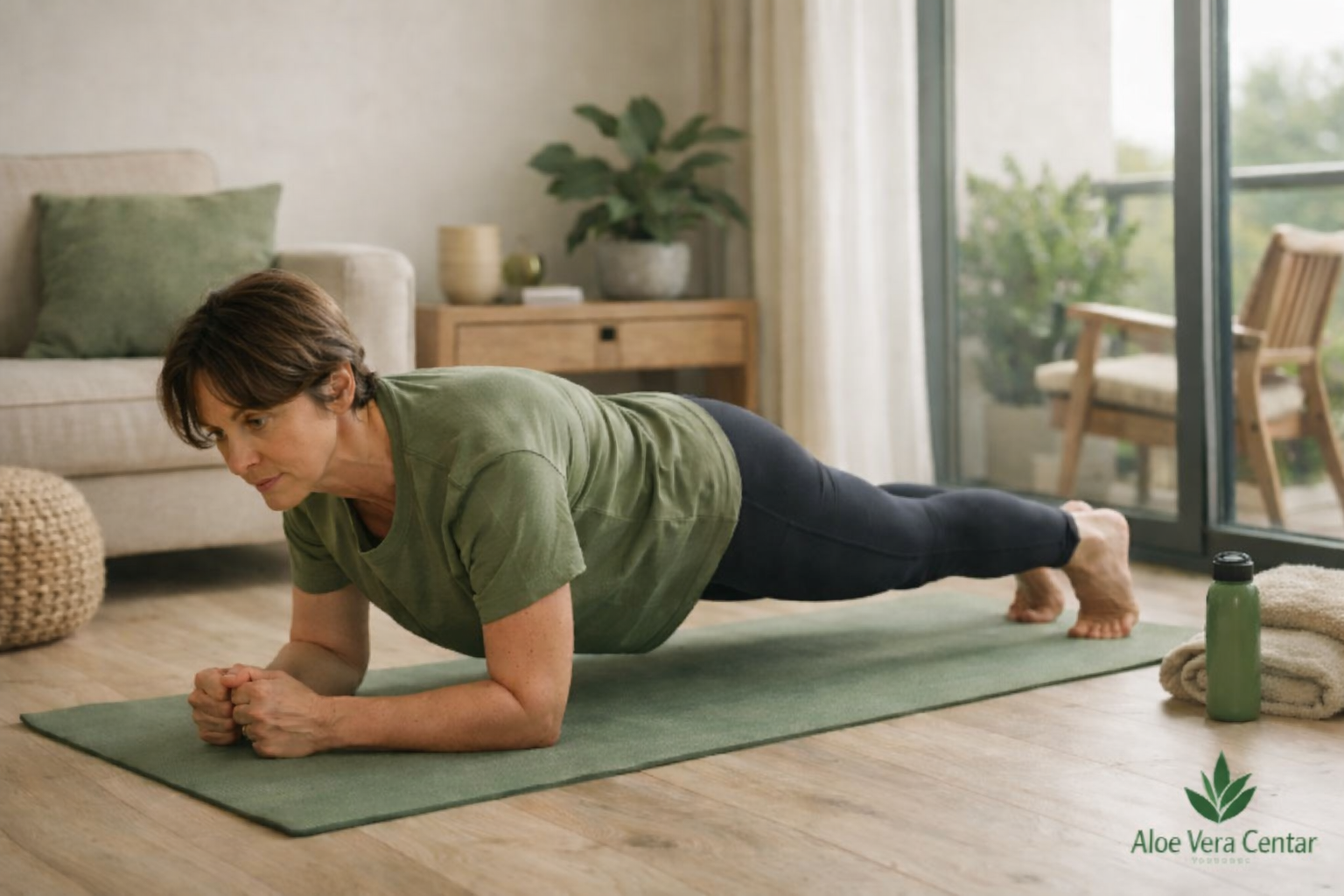
Exercise 5: Plank"tap"for a stable trunk
In plank, the goal is stability, not suffering. Place your palms under your shoulders. Make a light touch on the opposite shoulder. Then switch sides.
Hips remain still. Do not"dance"left and right. If it's hard, spread your feet. If it's still hard, work on the elevation.
- Initial: plank on the elevation with wider feet
- Medium: plank"tap"on the floor
- Advanced: a slower"tap"with a longer hold
A short cooldown (2 minutes) after the last round
Cooling brings breathing back to normal. It reduces tension in the neck and hips. Don't skip it if you want a long-term routine.
- 30 s walking and calming breathing
- 30 s hip flexor stretch
- 30 s stretching the pectoral muscles against the wall
- 30 s easy"child pose"or sitting forward bend
How exactly to progress from week to week
Progress should be simple. Don't change everything at once. Change one thing a week. That's how you stay stable.
The first option is to increase the quality. Add a slower descent into the squat. Add a break to the push-up. That's progress without the added stress.
Another option is to increase the density. Stay at 45/15, but add more reps. Don't rush, but be determined. Sweat is a byproduct.
A third option is to add a fifth circle. You only do this when 4 rounds become a"normal thing". Then you have 25 minutes of work. And it's serious.
The most common mistakes that steal results
Mistakes are often simple. People repeat them because they want speed. And speed without control often leads to stagnation. Here's what to fix first.
- Skipping warm-up and cool-down
- Too fast push-ups with shoulder collapse
- Squat with heels off the floor
- Step-ups with the knees"running away"inside
- Plank with relaxed stomach and bent back
If you recognize two items, this is normal. You should not be discouraged. It's just a guide. Get started with one correction today.
Plan for the week: 3 training sessions without overloading
Three training sessions a week is a realistic goal. This often happens in life. You can train Monday, Wednesday and Friday. The weekend is left for walking.
On the days in between, add 20 minutes of walking. This will speed up recovery. And it will reduce tension after sitting. That part is often underestimated.
If you want an additional idea, check out the plan forDurable tires. It's a good add-on without being too heavy.
Water, electrolytes and energy during training
Dehydration lowers performance quickly. You often don't notice it in time. So drink water before training. Drink also after training.
If you sweat a lot, consider a plan forrehydration during training. There are practical frameworks and simple guidelines.
Nutrition after training without stress
After training, the goal is recovery. You don't need a perfect menu. You need a consistent framework. This preserves energy and mood.
You are looking for protein, fiber and healthy fats in your meal. This keeps you full and stabilizes your energy. It is easiest when you have a clear plate structure.
For a specific framework, read the guideHow to stack a plate. You will get simple logic without complications.
If your goal is body shaping, follow the principle of consistency. Don't hunt for the perfect week. You are hunting a solid month. That's what makes the difference.
For a realistic view of strength and body composition, it is a useful topicbody recomposition. There you will find practical guidelines.
What science says about intervals and short training sessions
Short training sessions can be very effective. Especially when they have intervals and good intensity. This is confirmed by the review on adaptations to interval training atPubMed.
For general recommendations for movement throughout the week, it is good to know the framework. The World Health Organization provides guidelines for aerobic work and strength. Check out the official synopsis atWHO website.
If you want a practical overview of the benefits of interval work, the article atHealthline. It is especially good for quickly understanding"why".
How to track progress without weighing yourself every day
Progress can be seen in several ways. You can track the number of quality push-ups. You can monitor the depth of the squat. You can monitor your heart rate after the lap.
Do a"test circuit"once a week. Write down how many repetitions you do in 45 seconds. Also write down how you felt. This is your real indicator.
Another sign is easier breathing. If you calm down faster after training, that's progress. If your posture is better, that's progress. Don't underestimate it.
If you work at the computer: your back and neck are looking for a plan
Sitting shortens the hips and puts strain on the neck. That's why circuit training is a great contrast. But you also need small habits throughout the day. They protect the body.
For practical workplace adjustments, see the guide toergonomics. Sometimes one stool correction changes the week.
If you feel pain, reduce the intensity. Choose slower variants. Avoid jumping for a while. You can still progress.
Optional support that often fits well
If your focus is on healthy fats, consider omega-3 sources. They are part of nutrition and recovery. One of the options isForever Arctic Sea Omega.
If you have sensitive joints, choose smart exercise options. Add more walking. Some also choose joint supplements for support. One of the options isForever ESM Complex.
Conclusion: 20 minutes that take back control
Bodyweight circuit training works because it's simple. It has a clear structure. It has enough intensity. There is also room for customization. When you do it, the day is often"rearranged". That's great value.
If you want to personalize the plan, you can use oursAI advisors. There you can describe your goal and level of readiness.
For inspiration on how modern technology and AI are used to build a global online business, read the articleHow this couple is building a global business with AI and working 95% online.
Note: This article serves information and education. It does not replace the advice of a doctor or specialist. If you have health problems, pain or are taking therapy, consult a doctor before making changes in training and supplementation.
Frequently asked questions
How many times a week should I do this circuit training?
For most people, 3 training sessions per week are ideal. That's how you progress and recover. If you are a beginner, start with 2.
Is this suitable if I am overweight?
May be suitable with adjustments. Choose push-ups on elevation and without jumps. Keep the pace moderate and focus on form.
What if my knees hurt when squatting?
Reduce the depth and work up to the chair. Make sure your knees follow your toes. If pain persists, seek professional evaluation.
How do I know I'm working hard enough?
In work, you should be at an effort of 7 to 8 out of 10. You can speak short sentences. You should not be completely"out of breath".
Products most closely related to this topic
If you want to compare concrete options after reading, these products are the closest match to the article topic.
Arctic Sea OmegaA supplement for energy, heart and circulation routines when you want longer-term daily support.
Useful to compare when you are looking for energy, focus or vitality support.Forever Fiber - FIBERA simple fiber add-on when you want digestion and satiety support during the day.
It fits topics such as appetite, portions, energy or a weight-management routine.Forever ESM Complex – Joint Support!Support for a mobility routine when joints, movement and everyday flexibility are the topic.
Useful to compare when joints, bones or mobility are the topic.Short answers that help
If you are still comparing options, these are the points worth checking before you continue.
What should I take from this article?
Use it to understand the topic in practical terms and compare it with your current routine, needs and next step.
When does it make sense to ask for a recommendation?
Ask when the topic feels relevant, but you are not sure which Forever Living Products product or routine fits you best.
Does this article replace professional advice?
Circuit training with your own weight (20 min): plan for strength and fitness is educational content. For medical conditions, medication, pregnancy or persistent symptoms, include qualified professional advice.
Describe what you want to achieve
If you do not know which product to choose, write your goal, habits or doubts and get a more concrete suggestion.
Recommended products



Related articles to keep exploring