
The key points from this article
- Jednostavan dodatak vlakana kada želiš podržati probavu i osjećaj sitosti kroz dan.
- You may have bloating, loose stools or fatigue.
- For a personal choice, continue with a recommendation after reading.
Products most closely related to this topic
If you want to compare concrete options after reading, these products are the closest match to the article topic.
 Forever Active Pro B
Probiotic support when you want an easier daily way to care for digestion.
It makes sense if you are looking at the topic through digestion and a simpler daily routine. Forever Fiber - FIBER
A simple fiber add-on when you want digestion and satiety support during the day.
It fits topics such as appetite, portions, energy or a weight-management routine. Aloe Vera Gel
A daily aloe drink for people who want simple support for digestion and routine.
It makes sense if you are looking at the topic through digestion and a simpler daily routine.Fiber and a healthy microbiome: realistic amounts you can actually track
Fiber and a healthy microbiome they often sound like a topic for experts. But it is actually very practical. You may have bloating, loose stools or fatigue. You may feel that you are eating"healthy", but your digestion is not cooperating. Sound familiar?
This article is your realistic guide. Not a theory. The focus is on quantities that you can track every day. You'll learn how much fiber to target, how to increase it without problems, and what habits help the microbiome the most. Let's start simply. One step at a time.
What is the microbiome and why is it so interested in fiber
The microbiome is the community of microorganisms in the gut. They are not enemies. In most cases, they are your allies. They help break down food and create useful compounds.
Here's the thing: a lot of good bacteria love food that you don't digest. These are mostly fibers. When fiber reaches the large intestine, some of it is fermented. Then short-chain fatty acids are formed.
Fiber fermentation is one of the key topics in gut science. If you want a deeper explanation, take a looka PubMed review on short-chain fatty acids.
Realistic Fiber Amounts: Which is a good goal for most people
The most common problem is not"too many probiotics". The problem is too little fiber. Most adults don't even come close to having a good intake. That's why the microbiome gets too little fuel.
As a practical goal, a range of 25 to 35 grams of fiber per day helps many people. If you are more active and eat more calories, the goal can be higher. If you have sensitive intestines, the goal is still achievable. It just needs to be slower.
European guidelines often state 25 grams as an adequate intake for normal bowel function. You can read more details insummary of the EFSA recommendation on fiber intake.
In practice, it is useful to have three goal levels. This reduces the pressure. And it gives you clear steps.
- Starting level: 15 to 20 g per day, if you currently eat little fiber.
- Stable level: 25 g per day is a good minimum for most adults.
- Advanced level: 30 to 40 g per day, if your digestion tolerates it well.
How to know how much fiber you already eat
You don't need to weigh every meal. But you need a realistic feeling. The fastest test is"three days of recording". You only enter fibers. Nothing else.
Read the declarations. Look at"fiber"per 100 g or per serving. For fresh food, use general values. They are enough for a good overview.
For an even more practical approach, set three anchors of the day. These are breakfast, one snack and dinner. Insert one fibrous food into each anchor. This is the easiest way to get 10 to 15 g per day.
Top sources of fiber and microbiome, without complications
Different fibers feed different bacteria. That's why variety is more important than perfection. You don't need 20 superfoods. You need 6 to 10 basic sources throughout the week.
Soluble and insoluble fiber: what the difference means to you
Soluble fibers form a gel in digestion. They often help satiety and stool stability. Insoluble fiber increases stool volume. They often help bowel movements.
In real life, you don't have to share exactly. Just combine sources. An example is oats with fruit. The second is vegetables with legumes.
Prebiotics: fibers that are especially loved by"good"bacteria
Prebiotics are a type of fiber. They selectively feed beneficial microorganisms. It's not a marketing ploy. It is a concept from research.
Practical prebiotics in food are onions, leeks and garlic. There are also oats, barley and legumes. Also chilled potatoes or rice. It contains resistant starch.
The most common mistakes when increasing fiber
You may be wondering why people feel worse when they go"healthier". The reason is often speed. Fibers increase rapidly. Water and movement remain the same.
The first mistake is jumping from 10 to 30 grams in a couple of days. Another mistake is too little liquid. The third mistake is relying only on bread and cereals. Then diversity suffers.
If you're bloated, you need a smart pace. In this case, a topic guide can helpbloating after certain foods.
Protocol"+5 g per week": the simplest way without stress
This is a realistic strategy for most people. You increase fiber by about 5 g per week. Not every day. And not at once. Thus, the intestines have time to adapt.
How does it look in practice? You add one thing. Keep it for 7 days. Only then add the next one.
- Week 1: 1 apple or pear a day.
- Week 2: 1 serving of oats or bran several times a week.
- Week 3: 1 serving of lentils or beans twice a week.
- Week 4: additional vegetables with lunch and dinner.
Water and movement: the"invisible"part that makes the difference
Fiber without water often creates a problem. The stool may become harder. Bloating may increase. That's why liquid is part of the plan.
You don't have to drink liters at once. The goal is evenly throughout the day. If you need clear numbers, see the guide forwater intake.
Movement additionally helps peristalsis. You don't have to train hard. A quick walk is enough. Especially after a meal. It's a small move with a big impact.
The chair as a signal: what is"normal"and what requires adjustment
The best feedback is not a scale. Neither is the app. It's your digestion. The goal is regular and light stools, without straining.
If constipation occurs, first look at the rate of increase in fiber. Then look at the water and the movement. Only then are you looking for additional tools.
For a broader context, it is useful to read the article on the topicprison.
Where accessories fit in: smart, discreet and targeted
Food is the base. But sometimes you want a simpler way. Especially when you are at work, on the road or in a stressful period. Then a fiber supplement can be practical.
If you're looking for a product designed to support fiber intake, take a lookForever Fiber. Always start with a smaller dose. Track how you feel.
Another angle of the story is the balance of intestinal flora. Food with fermented foods helps many. For some, a more practical and targeted supplement is formulated. In that case it can be interestingForever Active Pro B.
Small plan for 1 day: 30 g of fiber without"tricky"recipes
This is an example, not a rule. The idea is to see what 30 looks like. Everything is feasible even in a busy day.
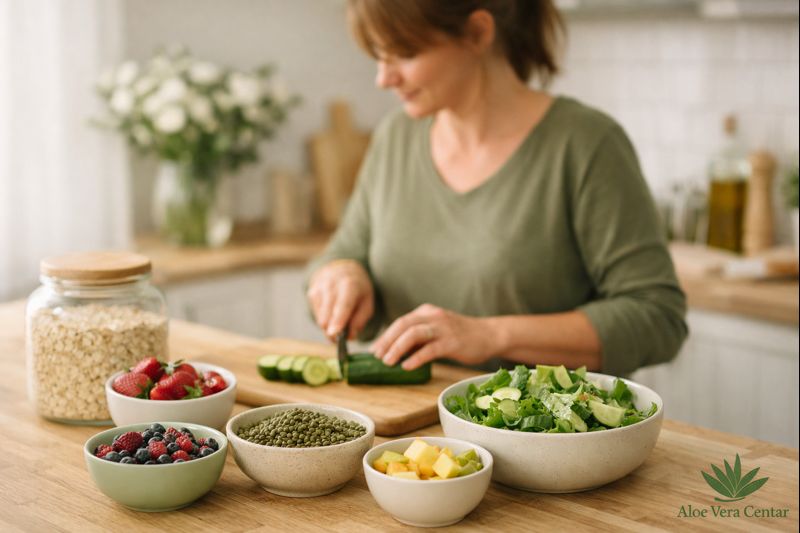
- Breakfast: oatmeal with fruit and a spoonful of seeds.
- Snack: an apple or berry, plus a handful of nuts.
- Lunch: lentils or beans with a large salad.
- Dinner: vegetables in the pan and a source of protein, along with some whole grains.
If you want a more structured approach, it's good to have plate and portion boxes. That's where it helpsdiet plan which is complex to digest.
When you need to be careful with fibers
Fiber is not"the more the better"for everyone. If you have active intestinal inflammation, severe symptoms or recent surgery, you need an individual approach. The same applies to sudden stool changes and unexplained pain.
In these situations, the goal is safety. Sometimes the fibers shrink temporarily. Then they return gradually. Always in agreement with an expert.
Frequently asked questions
How much fiber do I need per day, if I want a healthy microbiome?
For most adults, a good goal is around 25g per day. If you tolerate it well, you can go towards 30 g. The key is gradualness and variety of sources.
Why does fiber make me gassy and bloated?
The most common reason is too fast growth of intake. Another reason is too little water. The"+5 g per week"rule and more movement help.
Are fiber supplements a good substitute for food?
I can't replace the variety of food. But they can be a practical support. Especially when the schedule is tight and the meals are irregular.
Can fiber help with constipation without laxatives?
They can often help, if introduced gradually. Water and movement are important. If the problem persists, talk to your doctor.
Bottom line: the microbiome likes routine, not perfection
Fiber is one of the strongest and most underrated habits. You don't need extreme. You need consistency. Aim for a realistic range and build it up over weeks.
For inspiration on how modern technology and AI are used to build a global online business, read the article"How this couple is building a global business with AI and working 95% online".
Note: This article is for informational purposes only and is not a substitute for professional medical advice. If you have a diagnosis, treatment or serious symptoms, talk to your doctor or nutritionist.
Products most closely related to this topic
If you want to compare concrete options after reading, these products are the closest match to the article topic.
Forever Active Pro BProbiotic support when you want an easier daily way to care for digestion.
It makes sense if you are looking at the topic through digestion and a simpler daily routine.Forever Fiber - FIBERA simple fiber add-on when you want digestion and satiety support during the day.
It fits topics such as appetite, portions, energy or a weight-management routine.Aloe Vera GelA daily aloe drink for people who want simple support for digestion and routine.
It makes sense if you are looking at the topic through digestion and a simpler daily routine.Short answers that help
If you are still comparing options, these are the points worth checking before you continue.
What should I take from this article?
Use it to understand the topic in practical terms and compare it with your current routine, needs and next step.
When does it make sense to ask for a recommendation?
Ask when the topic feels relevant, but you are not sure which Forever Living Products product or routine fits you best.
Does this article replace professional advice?
Jednostavan dodatak vlakana kada želiš podržati probavu i osjećaj sitosti kroz dan.
Describe what you want to achieve
If you do not know which product to choose, write your goal, habits or doubts and get a more concrete suggestion.
Recommended products



Related articles to keep exploring