In this guide
- Wellness breaks: stretching, breathing and music for more focus throughout the day
- Why wellness breaks work
- Stretching in 60 to 90 seconds
- Breathing as a quick reset of the nervous system
- Music that works for you
- Mini drinks and micro-energy
- How to arrange wellness breaks throughout the day
- Rituals for the home office
- Mini protocols for the most common scenarios
- The most common mistakes and how to avoid them
- Bonus: outdoor wellness breaks
- Taking care of hydration and electrolytes
- Frequently asked questions
- Conclusion
- Common questions
Wellness breaks: stretching, breathing and music for more focus throughout the day
Wellness breaks are small but powerful rituals that fit into any crowd. If you often find yourself rushing from task to task during the day, and your energy drops just when the most important task needs to be completed, you are not alone. Good news? 60 to 180 seconds of proper stretching, deep breathing, or the right tune is enough to give your body and brain a reset. Sound too good to be true? Continue reading.
In the following lines, you will receive specific, proven suggestions for daily wellness breaks which you can apply immediately, in the office or at home. In addition, I'll share short protocols, schedule suggestions, useful tools, and time-saving potions that restore focus and good mood.
Why wellness breaks work
Our body likes the rhythm of tension and relaxation. Short breaks break the cycle of accumulated stress and return you from"fight or flight"mode to a state of better concentration. If your work is demanding or you sit for more than 6 hours, breaks are just as important as the work itself. Even better, they are a preventative strategy forstress at work, tight neck, stiff back and tired eyes.
Here's the thing: when you fit 3 to 6 short breaks into your day, you reduce physical tension, stabilize your breathing, and micro-reset your mood. The result is more energy exactly when you need it.
Stretching in 60 to 90 seconds
Stretching is the fastest way to break through stiffness and signal to the nervous system that it's safe to release the brakes. You don't need a prop. Just stop, take a breath and follow these mini protocols.
1) For the neck and shoulders
- Seated head turn: sit up straight. Gently turn your head to the left until you feel a slight stretch, count to 10, then to the right another 10. Repeat 2 times.
- Lowering the ear towards the shoulder: ear to shoulder, shoulders relaxed. Hold for 15 seconds each side. Add a gentle tug with your hand if it fits.
- Shoulder circles: 10 small circles forward and 10 back. Breathing evenly.
2) For the upper back and chest
- Opening the chest with the handle: palms on the doorpost, one foot step forward. Lean slightly and hold for 20 seconds. Feel the stretch in your chest, not your shoulders.
- Cat-cow for the office desk: palms on the thighs, inhale the back slightly into the arch, exhale round the spine. 6 to 8 repetitions.
3) For hips and lower back
- Quadriceps with a chair: stand against the back of the chair, grab your foot and gently bring your heel closer to your butt. 20 seconds per leg.
- Figure 4 sitting: ankle over the opposite knee, lean forward slightly. 20 to 30 seconds, then replacement.
4) For eyes and head
- The 20–20–20 rule: every 20 minutes, look at an object 20 feet (about 6 meters) away for 20 seconds. Your eyes will thank you.
- Soft blink: blink rapidly for 5 seconds, then close your eyes and take a deep breath. Repeat 3 times.
Expert advice: stretching works even better if you combine it with calm breathing. If you exercise without music, you additionally strengthen the awareness of movement. Read more about it in the articletraining without music.
Breathing as a quick reset of the nervous system
When you breathe shallowly, the body remains in a slightly tense mode. Deep, conscious breathing lowers the heart rate, lowers tension and restores clarity of thought. Here are three techniques you can literally do at your desk.
1) Breathing 4–7–8
- Breathe in through your nose for 4 seconds.
- Hold your breath for 7 seconds.
- Exhale slowly for 8 seconds through your mouth with a slight noise.
- Repeat 4 to 6 cycles. Enough for 1 to 2 minutes.
This technique is great before an important call or when you feel a rush of worry. Read more about the mechanism of action on the pagesHealthline about 4–7–8 breathing.
2) Box breathing
- Inhale for 4 seconds, hold for 4, exhale for 4, hold for 4. That's one “square”.
- Go through 4 to 5 squares and feel your thoughts becoming clearer.
Practitioners love it because it is rhythmic and simple. See the guide for more detailsbox breathing.
3) Diaphragmatic breathing
- One hand on the chest, the other on the stomach.
- Breathe in through your nose so that your stomach rises more than your chest.
- Exhalation slow and silent. 10 to 12 breaths.
This is an exercise that nourishes the nervous system. Harvard Health explains the benefits well in an articlebreath control and relaxation.
Quick hack: add a drop of scented oil to a handkerchief and inhale through your nose for 30 seconds. Olfactory stimuli and breath together are a powerful duo. If you are interested in scents that calm or energize, take a look at the guidearomatherapy essential oils.
Music that works for you
Music is the fastest mood regulator. A 90-second song can change your heart rate and muscle tone. The trick is to choose the tempo and mood.
How to choose a pause list
- To calm down: instrumental, 60 to 80 BPM, no vocals. Ambient, classical or lofi rhythms.
- For energy: 100 to 130 BPM, positive choruses, clear rhythm.
- For focus: minimalist melodies and repetitive rhythm without unexpected transitions.
Do you want to put together a list that increases performance in 2 minutes? See practical tips in the articleThe influence of music on performance.
Mini drinks and micro-energy
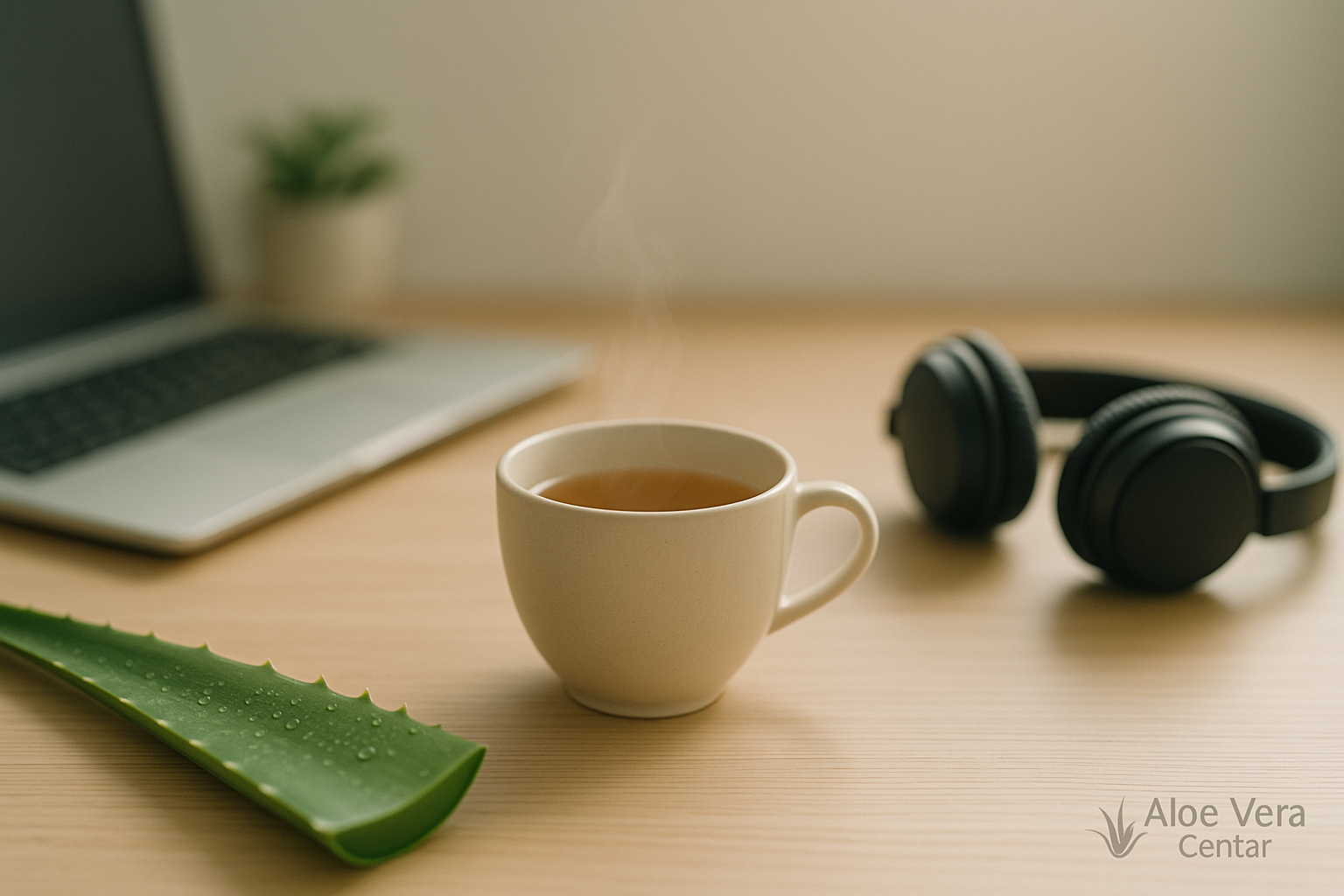
It is worth drinking a few sips of liquid during the break. Dehydration of only 1 to 2 percent can reduce concentration, so it is good to monitorwater intake. If you want something pleasant, warm and without sugar, consider herbal tea with delicate floral notes. It's a great optionAloe Blossom Herbal Tea which fits into the afternoon break without energy drops.
Do you prefer something slightly fruity? Then it is convenient to include a few sips in the morning routineAloe Vera juice. In addition to being moisturizing, it is a pleasant ritual for many to mark the beginning of the work block.
You might be wondering why? A little water, a conscious breath and a favorite tune are often enough for the body to get back in line with what needs to be done.
How to arrange wellness breaks throughout the day
The plan is half the job. If you leave the breaks to chance, you can easily skip them. That's why I suggest"lighthouses"during the day.
An example of a flexible schedule
- 08:55 short neck and shoulder stretching, 60 seconds.
- 10:30 breathing 4–7–8, 2 minutes.
- 12:20 walk to the window, 20–20–20 rule for the eyes, 60 seconds.
- 14:30 music break for focus, 90 seconds.
- 16:00 chest opening along the doorframe, 60 seconds.
Do you want a system that"reminds"you and keeps you on track? Build breaks into your daily routine with a frameworkDMO routine. Additionally, if you struggle with afternoon lapses, consider a targeted cognitive focus support such asForever Focus. The key is to stick to a low dose and test how your body reacts over the course of a week.
Rituals for the home office
The home office is full of pitfalls: the fridge, notifications, sitting too long. So add quiet minutes without a screen to your schedule. Read how ten minutes of guided silence resets the mental system in the articleThe power of silence. Pair it with a short walk around the apartment and a few diaphragmatic breaths by the window. Small steps, big impact.
Mini protocols for the most common scenarios
When you're tense before a meeting
- 1 minute: box breathing.
- 30 seconds: chest opening along the doorframe.
- 30 seconds: soft blinking and looking into the distance.
After 2 hours of sitting
- 30 seconds: shoulder circles and cat-cow.
- 30 seconds: figure 4 sitting left and right.
- 30 seconds: 4–7–8 breathing.
Afternoon energy slump
- 90 seconds: list from 100 to 120 BPM, without lyrics.
- 30 seconds: 6 to 8 deep breaths through the nose.
- Sip hot water or tea, as desired.
The most common mistakes and how to avoid them
- Excessive stretching: if you feel pain, stop one step before it. We are looking for a pleasant stretch, not a"tear".
- Breathing too fast: count within yourself and be guided by rhythm, not strength.
- Music with text during demanding work: the vocals are distracting. Choose instrumental when deep focus is needed.
- Too long breaks: the goal is 1 to 3 minutes, not 20. Short and often wins.
Bonus: outdoor wellness breaks
If you have a balcony, a yard or a nearby park, add 2 minutes of walking and fresh air. Sunlight also helps regulate the circadian rhythm, so you can fall asleep more easily later. This is important, because quality sleep makes focus more natural the next day.
Taking care of hydration and electrolytes
A minimum amount of water and an occasional isotonic drink can prevent headaches and loss of concentration. If you are active or exercise, it is useful to read the tips in the textrehydration during training.
Frequently asked questions
How often should I take wellness breaks?
Ideally every 60 to 90 minutes of work. If you are in the rhythm of"deep work", insert one longer break of 3 minutes after two blocks.
How soon will I feel the results?
Already after the first break, you can notice less tension in the neck and a clearer focus. Consistency throughout the week brings the feeling of a"lighter"working day.
Can I use music with lyrics?
Yes, if the work is not analytical or more routine. For demanding cognitive tasks, it is better to choose instrumental content without vocals.
Do I need nutritional supplements for better focus?
They are not necessary for everyone. Start with the basics: water, breathing, short walks, light. If, despite everything, you are looking for additional help, test the targeted products and monitor the subjective effect for 7 days.
Conclusion
Small breaks make a big difference. With 1 to 3 minutes of stretching, breathing and music at the right moments, you will get more focus, more stable energy and a calmer body tone. Start with one ritual and add another only when the first becomes a habit. If you need a personalized schedule, you canuse our AI advisor and get a break plan tailored to your day.
Finally, the reward for consistency: when you decide to treat yourself to a new tea or a smart supplement, check how to make it happen15% discount when ordering. Small changes today, better feeling already tomorrow.
Note: This content is for informational purposes and is not a substitute for professional medical advice. If you have chronic conditions, special medical conditions or are taking therapy, consult a doctor or qualified professional before starting new routines.
Common questions
What should I take from this article?
Use it to understand the topic in practical terms and compare it with your current routine, needs and next step.
When does it make sense to ask for a recommendation?
Ask when the topic feels relevant, but you are not sure which Forever Living Products product or routine fits you best.
Does this article replace professional advice?
Wellness breaks: stretching, breathing and music for better focus is educational content. For medical conditions, medication, pregnancy or persistent symptoms, include qualified professional advice.
Before first use
Choose products for your dietary routine and care needs. Follow a healthcare professional’s advice for diagnosis and treatment of symptoms. Check suitability first during pregnancy and for use by children.